


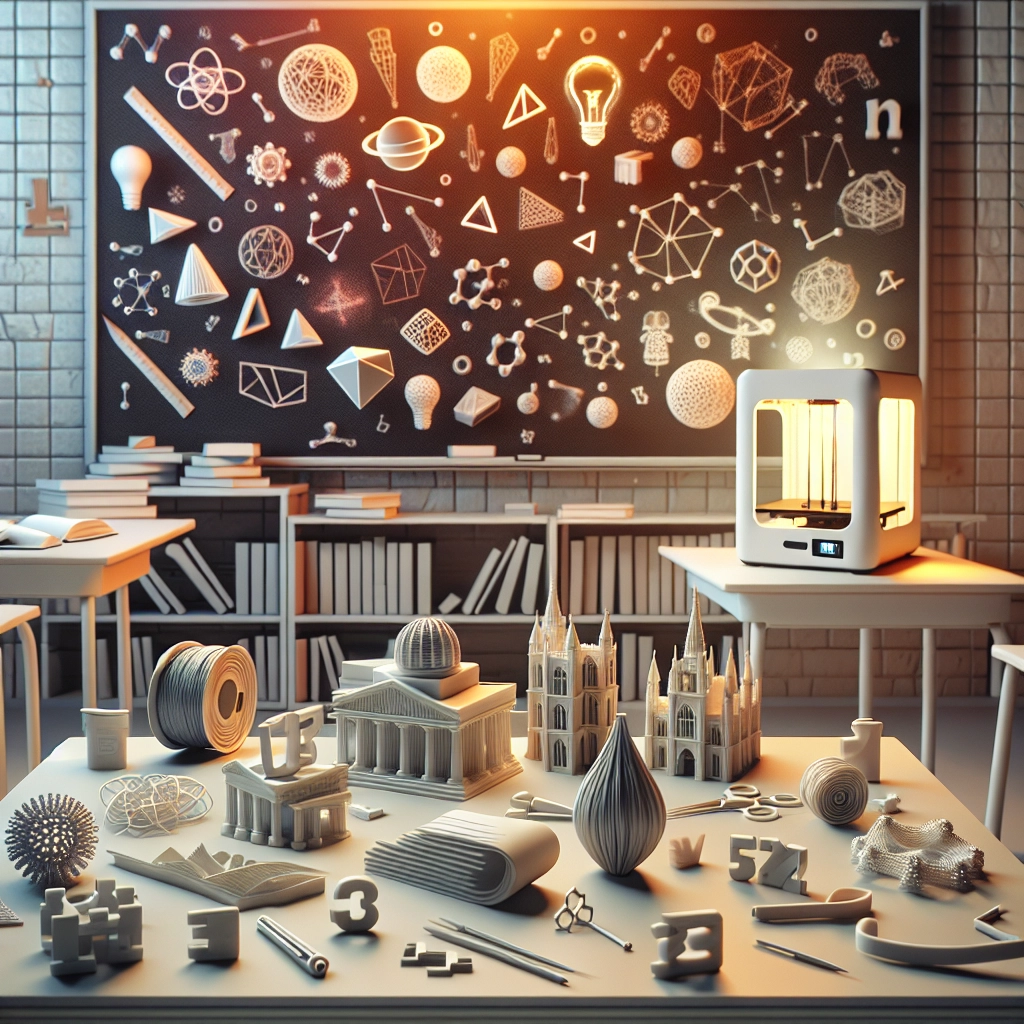
Unlocking Potential: Using 3D Filaments for Educational Purposes
In recent years, 3D printing has carved a niche for itself in various fields, ranging from manufacturing to healthcare. However, one of the most exciting developments has been its application in education. Imagine walking into a classroom where students don’t just read about scientific principles but actively create and examine their own three-dimensional models. Enter 3D filaments: a treasure trove of possibilities that can revolutionize the way we teach and learn.
What are 3D Filaments?
Before diving into their educational applications, let’s take a moment to clarify what 3D filaments are. Simply put, these are materials—mostly plastic—used in 3D printers to create physical objects. The most common types include PLA (polylactic acid), ABS (acrylonitrile butadiene styrene), and PETG (glycol-modified version of PET). Each of these filaments has unique properties, making them suitable for different tasks, and thus they form the backbone of 3D printing.
Sparking Creativity and Innovation
When we think of education, creativity often takes a backseat to memorization and standardized tests. But with 3D filaments, there’s a fantastic opportunity to spark innovation among students. In art and design classes, for example, students can create sculptures or customized products that represent their individual styles. They learn not just about aesthetics, but also about the importance of design thinking—considering how their creations will function in the real world.
Furthermore, when students design their own 3D models, they engage in critical problem-solving. They must consider material properties, structural integrity, and functionality. This real-world application of engineering concepts can deepen their understanding and make learning a lot more engaging.
Bringing Science to Life
Imagine a biology class where students can print models of cells, organs, or even entire organisms. With 3D filaments, complex biological concepts become tangible. Students can examine the intricacies of a human heart or a plant cell up close, gleaning insights that pictures in textbooks could never provide. This hands-on approach transforms passive learning into a vivid exploration of life sciences.
In addition to biology, physics can greatly benefit from 3D printing. Students can construct models of various forces, mechanisms, or even prototype inventions, seismic models, or complex geometries. The "aha" moments generated from hands-on experiments can transform students from mere learners into young inventors and scientists.
Enhancing Mathematics Education
Mathematics often gets a bad rap for being abstract and disconnected from reality. However, when you represent mathematical concepts through 3D printed objects, suddenly those numbers have a place in the physical world. Students can print geometric shapes, algebraic components, or even models representing complex equations.
For instance, consider the challenge of understanding a three-dimensional graph. By printing it out, students can manipulate the model, walk around it, and better grasp its dimensions and relationships. They’re no longer stuck on a flat page; they’ve got a three-dimensional playground for exploration.
Encouraging Collaboration and Teamwork
What’s a classroom without collaboration? 3D printing projects often require teamwork. When students work together to create a single model, they learn to share ideas and combine skills. They develop essential soft skills such as communication, problem-solving, and conflict resolution. Plus, there’s something deeply rewarding about turning a collective idea into a physical object that students can see, feel, and even take home.
In group settings, students can specialize in different aspects of the project, from design to printing to post-processing. This division of labor not only encourages accountability but also helps students appreciate diverse skill sets.
Accessibility and Affordability
One of the most inspiring aspects of 3D filaments is their accessibility. With decreasing costs of 3D printers and filaments, schools can now offer students technology that was once reserved for specialized institutions. Additionally, various online platforms offer a plethora of 3D models and designs that students can download and modify, further democratizing the learning process.
The Future of Educational Empowerment
Using 3D filaments in education doesn’t just unlock the potential of students; it opens doors to an innovative future. With industries increasingly leaning towards technology and innovation, equipping young minds with these tools can help them navigate tomorrow’s world of possibilities.
As educational systems evolve to embrace technology, integrating tools like 3D printing ensures that students are not just passive consumers of information but active creators who can think critically and innovatively. Ultimately, this approach aligns beautifully with the idea that education is not just about gathering facts but about fostering a mindset of discovery, exploration, and growth. The world is rich with opportunities, and with 3D printing, we can empower the next generation to grasp them with both hands.