


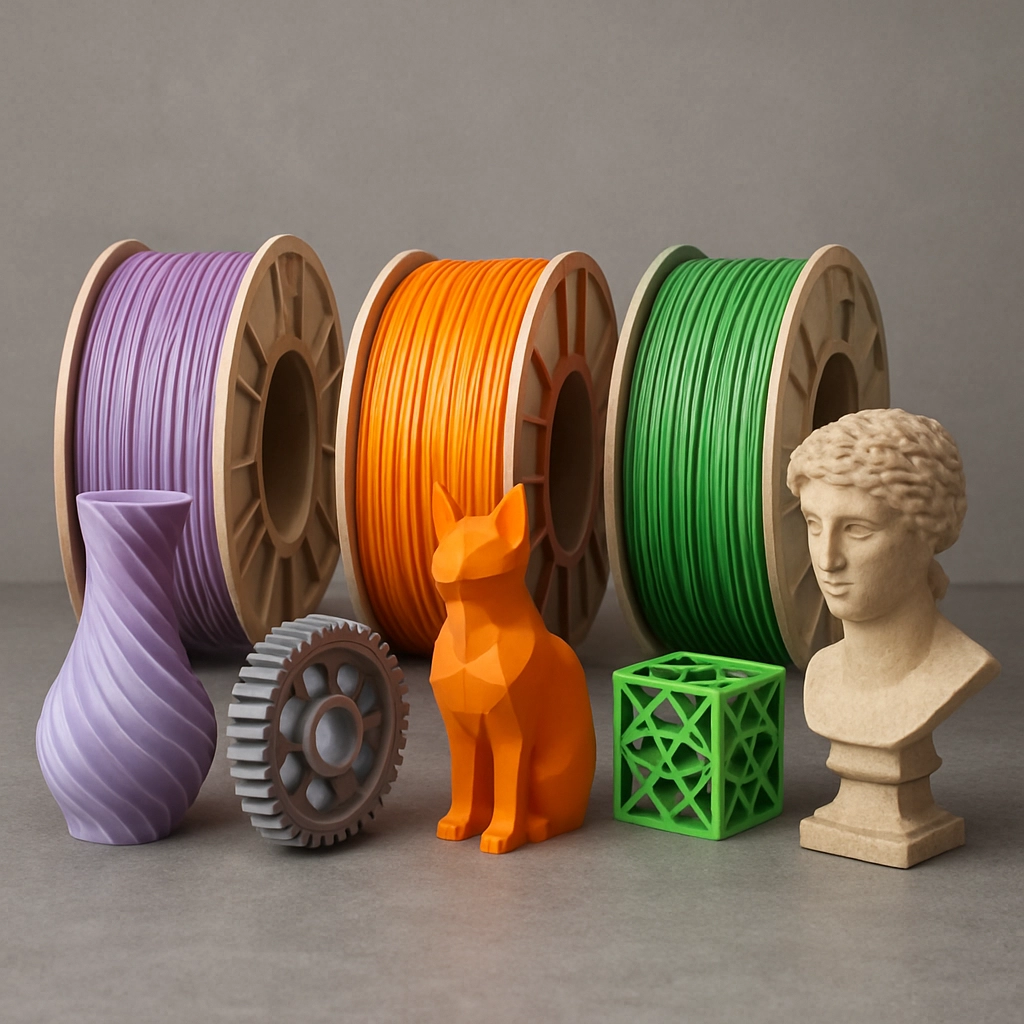
Exploring Different 3D Filaments: What’s Best for Your Projects?
If you’ve dipped your toes into the world of 3D printing, you’ve likely realized that the filament you choose can make or break your project. With a plethora of options available, selecting the right filament may seem overwhelming at first. But don’t worry! Let’s break it down and explore some popular filaments, their characteristics, and the types of projects they are best suited for.
PLA: The Friendly Beginner
Polylactic Acid, or PLA, is often the first choice for newcomers to 3D printing. It’s easy to use, biodegradable, and comes in a rainbow of colors. What’s more, it prints at lower temperatures, usually around 180-220°C, making it a great option for anyone just getting started.
PLA is perfect for decorative pieces, prototypes, and even some functional items. Its rigidity allows for detailed prints, but keep in mind that it can be brittle. If you’re planning to create a product that will be subjected to stress or heat (think: a cup for hot coffee), this might not be the best choice.
ABS: The Tough Guy
Acrylonitrile Butadiene Styrene (ABS) is the heavy-duty counterpart to PLA. Known for its strength and impact resistance, ABS is widely used for creating durable parts, models, and toys, like the beloved LEGO blocks. It can withstand higher temperatures (printing typically around 210-250°C) and is less prone to deformation compared to PLA.
However, ABS has a downside: it can be trickier to work with. It emits fumes while printing, which is not ideal for indoor use without proper ventilation. Additionally, it’s more prone to warping, so having a heated bed and an enclosed printer can help achieve better results. If you need something that can take a beating or be exposed to heat, ABS might be your best bet.
PETG: The Best of Both Worlds
If you’re caught in a tug of war between PLA and ABS, Polyethylene Terephthalate Glycol (PETG) could be your golden mean. This filament combines the ease of PLA with many of the strengths of ABS. It’s tough, flexible, and has good temperature resistance, while also being food safe and recyclable.
PETG prints at a temperature range of about 220-250°C and normally doesn’t require a heated bed, although it can help reduce warping. It’s perfect for mechanical parts, protective cases, and any project that might need some resilience—like that phone cover you’ve always wanted to print!
TPU: The Flexible Friend
For those unique projects that require flexibility, Thermoplastic Polyurethane (TPU) is your go-to. This filament is rubber-like, allowing you to create items that bend and stretch without breaking. Whether it’s custom grips, seals, or wearables, TPU provides incredible versatility.
Printing with TPU requires some adjustments, as its flexible nature can be a bit challenging. You’ll want to slow down your print speed and use a direct-drive extruder for the best results. If you have a creative project that needs that extra bit of stretch, then it’s time to embrace your flexible friend!
Nylon: The Strong and Versatile
Nylon is known for its strength and durability, making it the perfect candidate for functional parts that need to withstand stress and wear. It has a unique property that makes it somewhat resilient under impact, and its flexibility adds to its allure for engineering projects.
However, nylon is hygroscopic, which means it absorbs moisture from the air. This can affect print quality and lead to issues with adhesion, so it’s crucial to store it properly in a dry environment. For projects that demand toughness and resilience, like gears or functional prototypes, nylon could be the star of the show.
Choosing the Right Filament for Your Project
When it comes to choosing the best filament for your 3D printing endeavors, consider the purpose of your project and the qualities you need. Do you need something lightweight and easy to print? Perhaps PLA will suit your needs. Looking for durability? ABS or Nylon might be the way to go.
Ultimately, experimenting with different filaments can be a fun part of the 3D printing journey. You’ll not only learn more about your printer’s capabilities but find joy in bringing your creative ideas to life. From casual crafting to engineering feats, there’s a filament out there waiting to help you make something amazing! So, gear up, get printing, and unleash your imagination!