


How to Choose the Right Filament for Your 3D Printer
If you’ve recently taken the dive into the world of 3D printing, you’re probably already familiar with the excitement of bringing your digital designs to life. But as captivating as the process is, it can get a bit overwhelming—especially when it comes to choosing the right filament for your 3D printer. With the vast array of options available, it’s essential to understand what each type of filament can do and how it fits into your projects. So, let’s break it down!
Know Your Printer’s Specifications
Before you get too carried away with colors and textures, take a good look at your 3D printer specifications. Every printer has its own set of limitations when it comes to the types of filament it can handle. Most consumer-grade printers work well with PLA (Polylactic Acid) and PETG (Polyethylene Terephthalate Glycol). On the other hand, if you have a high-end machine, you might be able to experiment with nylon, TPU (Thermoplastic Polyurethane), or even metal-infused filaments.
Check your printer’s manual or manufacturer’s website to find out what materials are compatible. This will narrow down your choices and guide you toward what’s doable.
Understand the Properties of Common Filaments
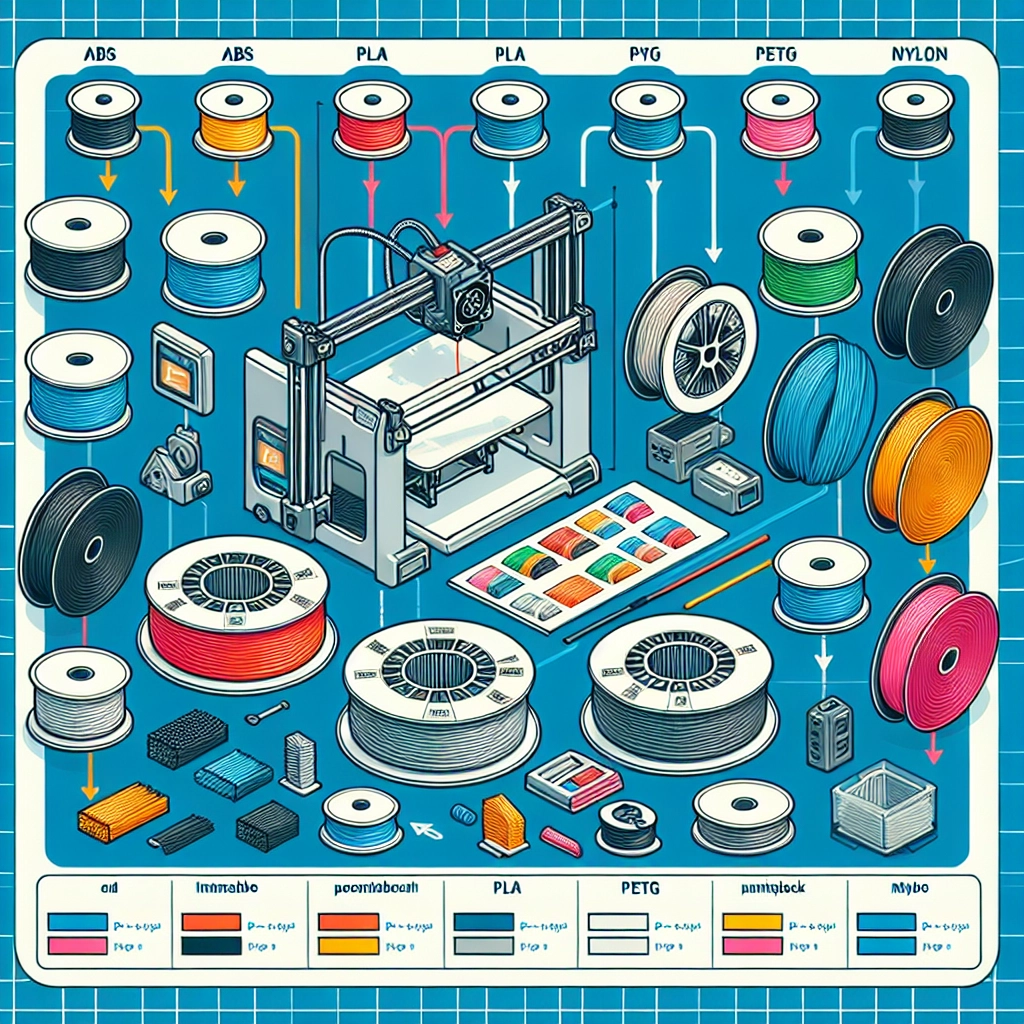
Here’s a quick rundown of some of the most popular types of 3D printing filaments, along with their characteristics:
PLA (Polylactic Acid)
- Ease of Use: PLA is the golden child of 3D printing. It’s non-toxic, biodegradable, and super easy to work with—perfect for beginners.
- Appearance: Available in various colors and finishes, including shiny and matte options.
- Applications: Ideal for prototypes, toys, and decorative items. However, it’s not the best choice for high-heat applications or outdoor use.
ABS (Acrylonitrile Butadiene Styrene)
- Durability: Known for its strength and heat resistance, making it great for functional parts.
- Challenges: However, it can be tricky to print because it emits fumes and requires a heated bed to prevent warping.
- Uses: Commonly used in automotive parts, appliances, and LEGO bricks.
PETG (Polyethylene Terephthalate Glycol)
- Balance: PETG brings together the advantages of both PLA and ABS, offering durability while still being relatively easy to print.
- Properties: It’s resistant to impact and moisture, making it suitable for outdoor use.
- Applications: Perfect for bottles, containers, and parts requiring strength alongside flexibility.
TPU (Thermoplastic Polyurethane)
- Flexibility: If you need rubber-like flexibility, TPU is your go-to filament.
- Printing Considerations: It’s great for things like phone cases or wearables, but it can be a bit finicky to print, requiring a precise setup.
- Difficulties: Print speed and settings need to be carefully controlled to avoid jamming.
Consider the Application
Think about what you plan to create. Will you be making intricate models, functional parts, or simple decorative items? The application will often dictate your choice of filament. For artistic projects, you might want to go with PLA for ease of use and vibrant colors. If you’re making something that needs to withstand wear and tear—like a tool or connector—ABS or PETG would be better options.
Finish and Aesthetics
Another fun aspect of choosing filaments is how they’ll look in your final product. There are glow-in-the-dark filaments, metallic finishes, and even wood-infused filaments that give a beautiful, natural touch. Decide on the aesthetic you’re going for and pick a filament that complements that vision.
Budget and Availability
Let’s face it—cost matters. Filament prices can vary greatly depending on the type and brand. While standard PLA and ABS can be found at reasonable prices, specialty filaments like nylon or carbon-fiber composites can hit the wallet hard. Keep an eye on what’s currently available locally or online and compare prices; sometimes, bulk buying can save you extra cash if you find a filament you love.
Test and Experiment
At the end of the day, the best way to find the perfect filament for your projects is to experiment. Purchase a few samples and give them a go on small projects before committing to a larger spool. This trial-and-error method can be both enjoyable and enlightening, leading you to discover new textures and finishes you may not have considered.
3D printing is as much about creativity as it is about technical specifications. With a bit of research and a willingness to experiment, you’ll soon find a filament that meets your needs and inspires you to create even more incredible projects. Happy printing!