
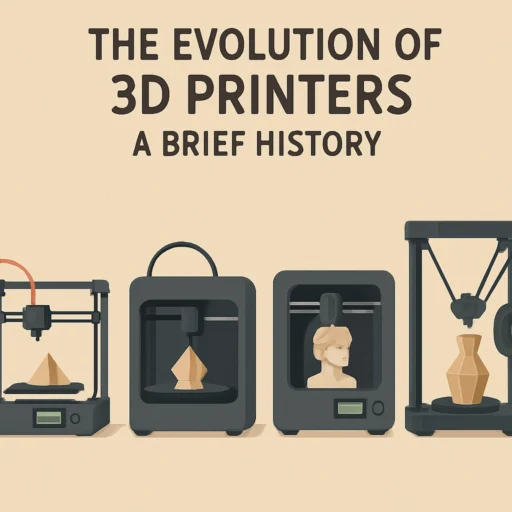
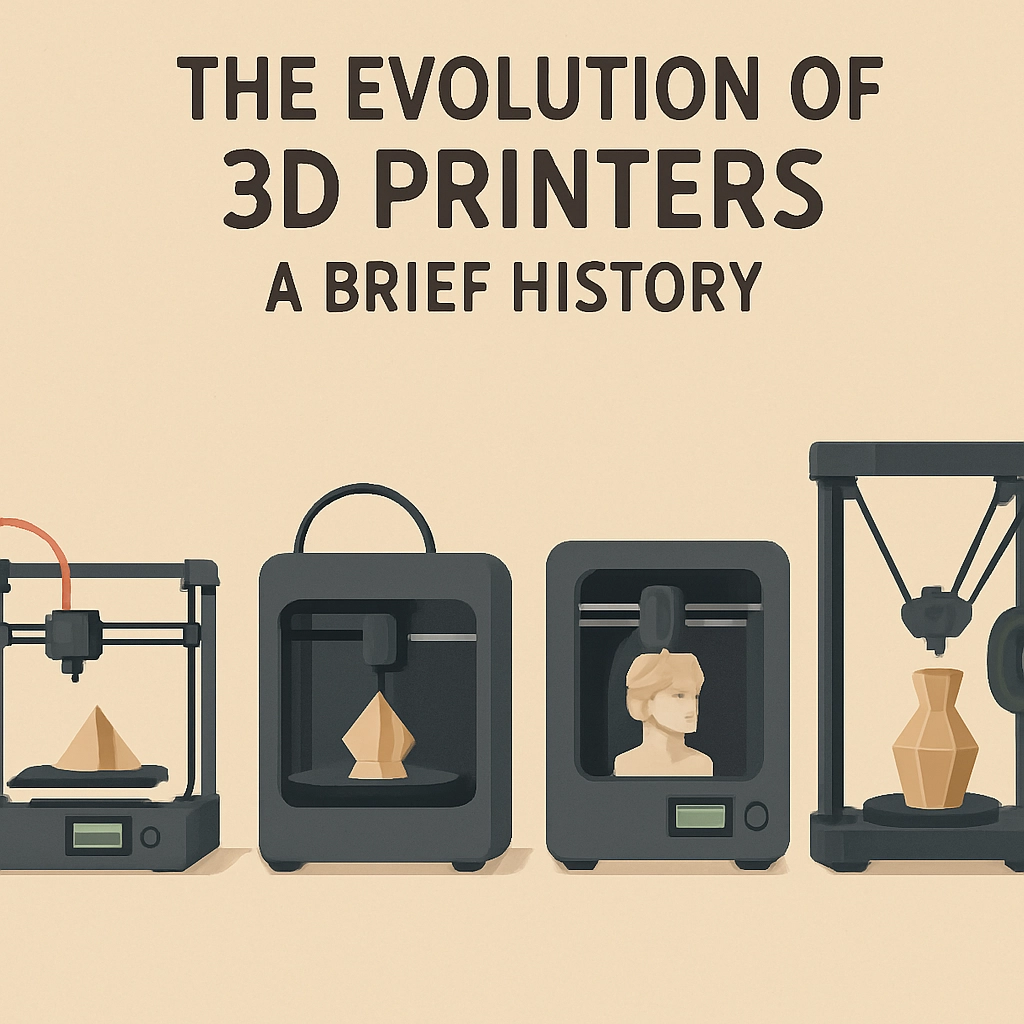

The Evolution of 3D Printers: A Brief History
3D printing, or additive manufacturing as it’s often called, has become a buzzword in the tech world, transforming industries from healthcare to construction. But how did we get to the point where printing a three-dimensional object is as easy as hitting “print” on your computer? Join me as we take a leisurely stroll down the memory lane of 3D printing’s evolution.
The Early Days: 1980s Beginnings
The story of 3D printing starts in the early 1980s. In 1981, Hideo Kodama of Nagoya Municipal Industrial Research Institute developed a method for producing a three-dimensional plastic model using a light polymer resin. However, it wasn’t until 1983 that Chuck Hull, co-founder of 3D Systems, filed a patent for a process known as stereolithography (SLA). This process involved using UV lasers to solidify layers of resin, creating intricate 3D models from a digital blueprint.
By 1988, the first commercial 3D printer—the SLA-1—was introduced. This was a game-changer that laid the groundwork for future innovations. Although the technology was expensive and primarily available for industrial use, it sparked curiosity in engineers and inventors, who began to explore the potential of what could be created layer by layer.
The 1990s: Pushing Boundaries
As we moved into the 1990s, 3D printing technology began to gain traction. The introduction of fused deposition modeling (FDM) by Scott Crump in 1988 marked a significant milestone. FDM creates objects by extruding melted thermoplastic material through a nozzle, laying down layers to form a solid object. This technique was not only more affordable but also easier to understand.
During this decade, patents were filed, and several companies, including Stratasys and 3D Systems, began to offer commercial printers. Educational institutions started to catch on too. By embracing this technology, universities enabled engineering students to experiment with design and prototyping, which spurred further innovation.
The 2000s: Opening the Floodgates
The 2000s saw a democratization of 3D printing. With advances in technology, the cost of printers began to drop, and the entry barriers for hobbyists and smaller businesses lowered significantly. In 2005, the invention of the RepRap project brought the idea of open-source 3D printing to the forefront. RepRap’s goal was to create a self-replicating machine, allowing users to print parts for their own 3D printers. This inspired countless DIY enthusiasts to build their own machines and share their designs online, leading to the rise of home 3D printing.
Around this time, the term "desktop 3D printer" became popular as consumers began acquiring smaller, more affordable models. Companies like MakerBot and Ultimaker emerged, making it easier for people to create everything from toys to intricate custom parts right in their homes.
The 2010s: Mainstream Adoption
With the 2010s came a whirlwind of advancements and applications. 3D printing exploded into various sectors: rapid prototyping gained prominence in manufacturing, while medical professionals began utilizing 3D printers to create customized implants and prosthetics. Print-to-order services sprang up, allowing users to upload designs online and have their items printed in a matter of days.
Moreover, major tech firms and even some car manufacturers started investing in 3D printing technology to streamline production, reduce waste, and create custom components. The most notable was the aerospace industry, where companies like Boeing and Airbus began using 3D-printed parts to improve efficiency and cut costs.
In 2013, the third dimension captured global attention with the launch of 3D printing pens and even the first 3D-printed human organ, a mini replica of a human ear! The technology began stirring up discussions about sustainability, potentially solving waste issues by reusing materials.
The Present and Future: Innovations Ahead
Now, as 3D printing continues to evolve, we find ourselves on the cusp of even more extraordinary advancements. The advent of new materials, such as bio-inks for printing tissues and organs, and even enhancements in metal printing, are changing the landscape. Researchers are exploring ways to use 3D printing in construction, leading to projects where entire homes can be created in a matter of days.
And let’s not forget the rise of AI-driven designs and automation, which could make it possible for anyone, regardless of their tech knowledge, to create complex objects seamlessly. The possibilities are endless!
3D printing has indeed come a long way since its inception in the 1980s. What started as an industrial curiosity has blossomed into a dynamic and transformative technology with applications touching every corner of our lives. As we look ahead, it’s thrilling to imagine the innovations that will continue to shape our world, one layer at a time.